Being Ewethful.

Hand spinning Yarn for Socks

3/6/2024

0 Comments

 
Picture
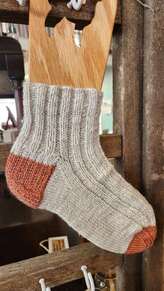
I cast on a new pair of socks (randomly) at the same time that I have been restocking the Prineville roving I designed with socks in mind! It got me to thinking maybe it's time to share some tips for handspinning sock yarn. Here are some of my top tips learned through the years:

  1. Use a strong wool. Socks take a beating so a stronger wool is going to hold up better. For the Prineville blend I chose Border Leicester wool. BL tend to fall into the micron count spectrum in the 30s making this a nice strong wool but no too prickly (did you know that your feet are much less sensitive to itch than other parts of your body?) Finer wools such as Merino and Cormo are much lower in microns so tend to be less strong and won't take the wear and tear of socks as well.
  2. Choose a wool that has a bit of a longer staple length. The shorter the staple the more chance for pilling and holes. Pilling occurs when shorter fibers start to pull out of a spun yarn, creating those little balls of fiber. I chose Border Leicester as it tends to have a staple length of 5+ inches meaning that it is less likely to pill. In contrast a Merino fleece average staple length is 2-3 inches making it easier for those shorter fibers to slip out over time.
  3. Mohair is a great substitute for nylon.  Nylon is a synthetic fiber - plastic - generally made out of petroleum. Guess what plastic does? Besides being bad for the environment, in socks,  nylon helps to create a hot sticky and stinky environment for our feet! The perks of using mohair (and wool) are it is a natural fiber so will reduce the sweating, plus mohair is very strong, and it has a beautiful luster.
  4. Put a little extra twist in your yarn when spinning. A smidge extra twist will add a little extra strength to your yarn. If you are spinning the yarn and then knitting the socks you want them to last! Pilling and wear occurs faster on a yarn that is lightly spun. So hold that fiber for an extra second before letting the wheel take the yarn in therein adding just a smidge of extra twist.
  5. Ideally a 3 ply plus yarn. The more plies, the stronger the yarn. I think you get the idea by now that we are going for a long wearing yarn. One ply, not super strong. Two plies, stronger. Three plies, even better!

And here is a bonus idea you can try. In a recent Zoom meet-up Jodi told us that at her local guild meeting a member mentioned that if you spin 2 of your singles in one direction and the 3rd in the opposite direction, it can make for a longer lasting sock yarn. Jodi managed to find this idea in Sarah Anderson's The Book of Yarn Designs. Example: spin 2 singles in standard Z twist (clockwise) and the 3rd single spin S twist (counterclockwise), then ply as you usually would (in this case S or counterclockwise)! Has anyone tried this? I'd love to hear your thoughts! Thanks for sharing Jodi!

If you loved these tips be sure you are signed up for my newsletter where you get early notice on new products plus plenty of spinning and knitting tips! Head to my website to sign up and to shop the above mentioned Prineville fiber... great for spinning socks!


Visit the Ewethful website
0 Comments


Leave a Reply.

    Author

    I am Kim Biegler, the owner and operator of Ewethful Fiber Farm & Mill. I create hand spinning fibers from locally sourced wool and teach others online how to hand spin their own yarn. 
    ​ewethfulfiberfarm.com

    Archives

    August 2023
    July 2023
    February 2022
    January 2022
    November 2021
    October 2021
    September 2021
    May 2021
    April 2021
    March 2021
    February 2021
    January 2021
    December 2020
    November 2020
    October 2020
    September 2020
    August 2020
    July 2020
    June 2020
    March 2019
    February 2019
    January 2019
    December 2018
    December 2017
    November 2017
    October 2017
    September 2017
    August 2017

    Categories

    All

    RSS Feed

Proudly powered by Weebly