|
I recently dove down a rabbit hole of handspinning wheels when I was sitting at my Ashford Kiwi wheel thinking to myself, why does the yarn on my bobbin look all wrong? Now keep in mind that this was my first spinning wheel, the wheel I spun on for years, but as of recently I mainly use it as the wheel I ply yarn on. Well there was a reason the yarn looked different. Not because it was wrong but as I found out thru research simply because of the type of wheel it is. I could not believe how much I didn't know about my wheels and want to share a little of what I learned with you here. Let's start with the basics, there are 3 main types of spinning wheel when it comes to mechanics. 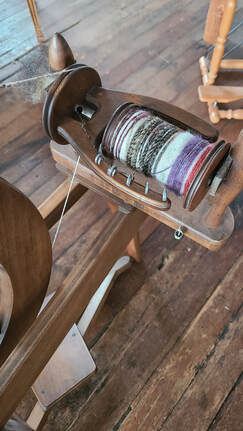 Pictured is an Ashford Traditional spinning wheel. You can see there is one band from the drive wheel to the flyer whorl. The Scotch Tension is the metal coil and wire to the right. Pictured is an Ashford Traditional spinning wheel. You can see there is one band from the drive wheel to the flyer whorl. The Scotch Tension is the metal coil and wire to the right. 1. Single Drive, Flyer lead or Scotch Tension wheels This is the most commonly used type of wheel. The Scotch tension wheel, as it is often called, allows for the most adjustments making it able to spin a lot of different yarn weights.
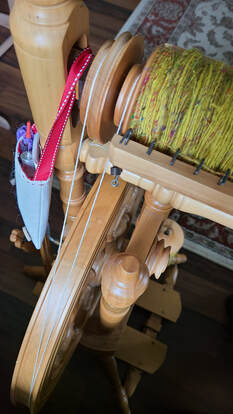 Pictured is a Kromski Minstrel spinning wheel. You can see the band loops from the drive wheel over the bobbin and the whorl of the flyer. Pictured is a Kromski Minstrel spinning wheel. You can see the band loops from the drive wheel over the bobbin and the whorl of the flyer. 2. Double Drive wheels This type of wheel has the ability to spin the finest yarns. This is also the most complex of the wheel types.
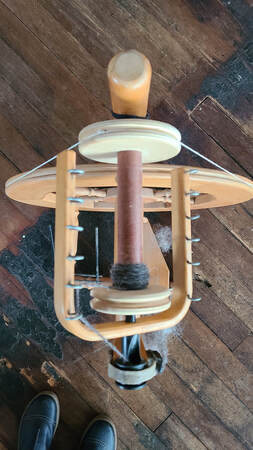 Pictured is a Louet S75 spinning wheel. You can see the band attaches from the drive wheel to the bobbin. In the lower portion of the photo you can see the band over the flyer shaft to adjusting tension. Pictured is a Louet S75 spinning wheel. You can see the band attaches from the drive wheel to the bobbin. In the lower portion of the photo you can see the band over the flyer shaft to adjusting tension. 3. Single Drive, Bobbin lead wheels This type of wheel is very simple but also the most difficult to make adjustments to.
I have garnered a lot of my information from a very comprehensive book called The Big Book of Handspinning by Alden Amos. This book is densely filled with all the information you may ever need to know about the craft.
So there you have it. A brief introduction into different spinning wheel mechanics! Please keep in mind that these 3 types come in all different shapes, sizes and styles. If you aren't sure what kind of wheel you have, sit down and take a look at how many band loops you have and where they are connected? This should help you answer the question. I also walk step by step thru the wheels in Episode 22 of Being Ewethful on YouTube. I will be going more in depth with each wheel over the coming months so please stay tuned for more videos that I hope will help you on your handspinning journey. What kind of wheel(s) do you have? What is your favorite and/or what wheel do you long to own one day? I would love to hear from you!
0 Comments
Leave a Reply. |
AuthorI am Kim Biegler, the owner and operator of Ewethful Fiber Farm & Mill. I create hand spinning fibers from locally sourced wool and teach others online how to hand spin their own yarn. Archives
August 2023
Categories |
 RSS Feed